
Hyaluronic Acid and Joint Lubrication: What the Science Shows
Synovial fluid depends on hyaluronic acid — and oral supplementation is generating more clinical evidence than many expected.
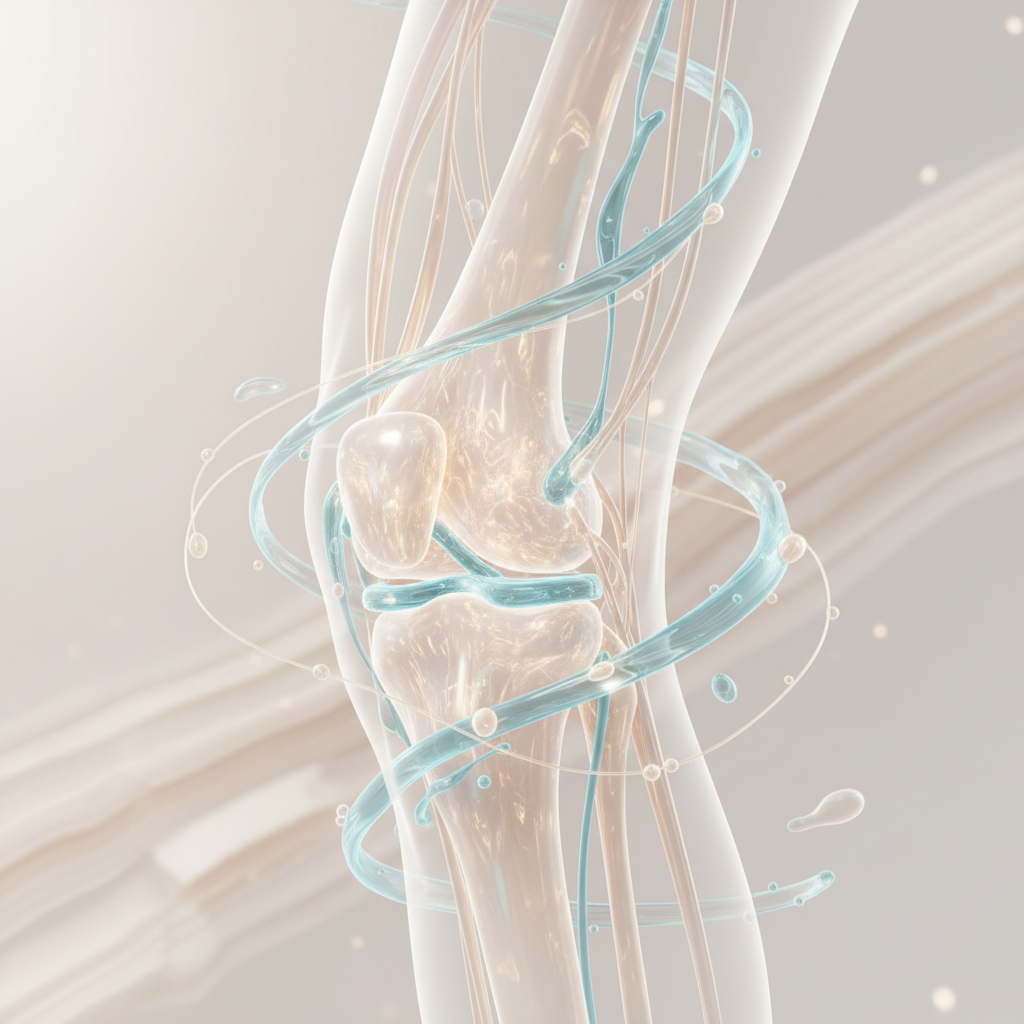
Walk up a flight of stairs, reach overhead, or simply stand from a seated position — and you are relying on a remarkable lubricant system most people have never thought about. Synovial fluid provides both lubrication and nutrition to cartilage surfaces, and its key structural component is hyaluronic acid.
Understanding what the research actually shows — and what it doesn't — helps adults make grounded decisions in a wellness landscape full of overconfident claims.
What hyaluronic acid does
Hyaluronic acid is uniquely capable of retaining water in proportions up to 1,000 times its own weight. In synovial fluid, it provides the viscosity and viscoelastic properties that allow it to act as a shock absorber under compression and a lubricant under shear stress.
With aging, HA concentrations decline. More significantly, the molecular weight decreases — and it is high-molecular-weight HA that provides optimal lubricating properties. Low-molecular-weight HA fragments have pro-inflammatory properties, adding an inflammatory dimension to mechanical deterioration.
The quality of synovial fluid — its viscosity, its HA concentration and molecular weight — is as important to joint function as the structural integrity of the cartilage it nourishes.
— Dr. Antoine Dufresne, MD, Hôpital du Sacré-Cœur, Montréal
Oral supplementation evidence
Intra-articular HA injections are well-established. Oral HA supplementation, which has faced bioavailability skepticism, has now been studied in multiple clinical trials. A 2008 trial in Nutrition Journal found that 200mg/day reduced knee pain and improved function over 8 weeks. A 2012 Japanese study found similar improvements over 12 weeks.
The proposed mechanism involves immune-mediated effects rather than direct synovial deposition. Orally ingested HA fragments are recognized by immune cells in the gut-associated lymphoid tissue and trigger systemic regulatory responses.
Combination approaches
Hyaluronic acid is increasingly formulated with collagen peptides, chondroitin, and glucosamine — reflecting the understanding that optimal joint matrix health requires multiple structural components simultaneously. Collagen type II combined with HA and chondroitin has been studied with synergistic results.
Quality varies meaningfully across products. Molecular weight specifications, sourcing, and combination formulation are practical considerations.
What sports medicine specialists recommend An oral HA supplement in the 200mg range — combined with collagen peptides and chondroitin — represents the current best-evidence oral approach to synovial fluid and joint matrix support.
The accumulated evidence supports a measured, foundational approach: consistent attention to the basics, supported by targeted intervention where the science is solid. That combination is where lasting wellness tends to be built.
References
- Nutrition Journal — Oral hyaluronic acid and knee pain RCT, 2008
- Journal of Medicinal Food — Oral HA in joint function
- Osteoarthritis and Cartilage — Viscosupplementation meta-analysis
Frequently asked questions
This article is for informational purposes only and does not constitute medical advice, diagnosis or treatment. Always consult a qualified healthcare professional before starting any supplement, diet or exercise programme, especially if you are pregnant, nursing, taking medication or have a medical condition. Statements about supplements have not been evaluated by the Food and Drug Administration.
Feel Better With Us Editorial Team
Our editors research every guide from primary sources and update it when the evidence changes. Our editorial standards